
Ford vs. Fujian
A Cage Match of Supercarriers

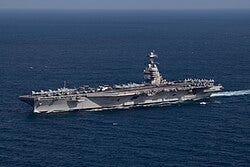
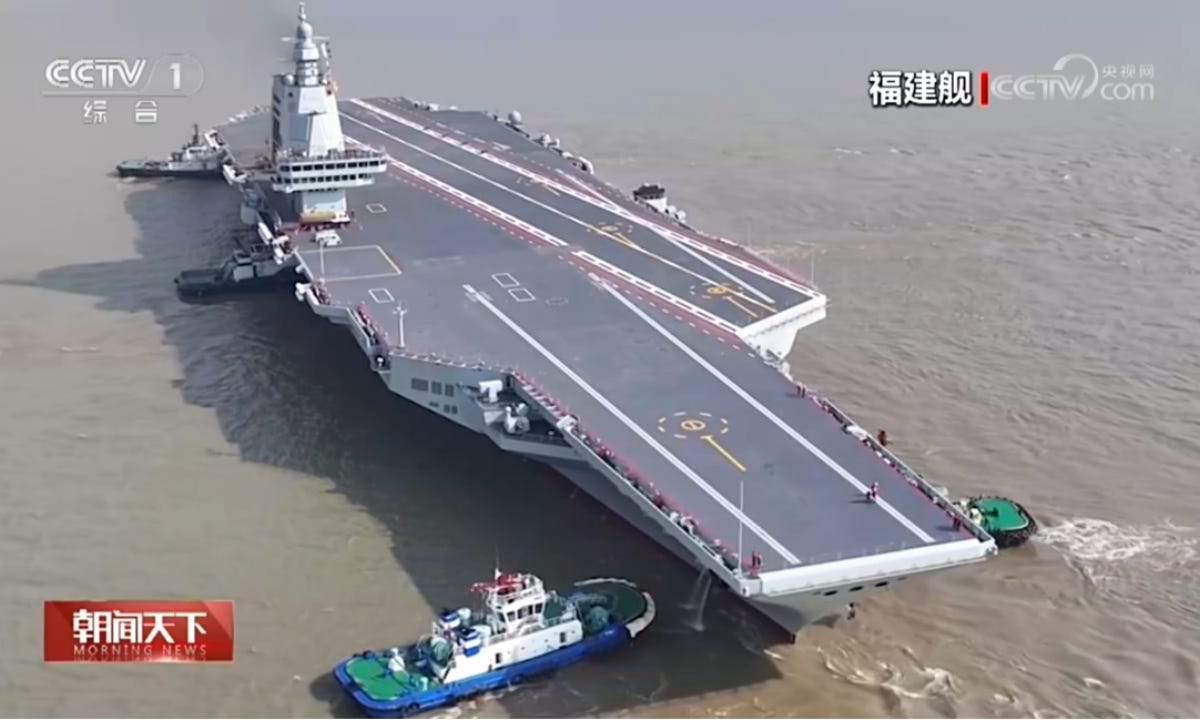
In the twenty-first century, the aircraft carrier continues to be the most important representation of naval power projection. Two ships in the current strategic environment, the USS Gerald R. Ford (CVN-78) of the United States and the Fujian (Type 003) of the People’s Republic of China, represent the technological pinnacle of their respective countries. These are more than 300-meter-long floating steel metropolises rather than just ships, signifying a significant conflict between naval doctrine, technological advancement, and strategic aspirations. A comparative evaluation of their main systems and operational environments is given by this analysis.
Propulsion and Launch Systems: Technological Maturity
The method of launching aircraft is a critical differentiator in carrier capability.
USS Gerald R. Ford: The Ford-class utilizes the Electromagnetic Aircraft Launch System (EMALS), replacing traditional steam catapults. This system employs linear induction motors to propel aircraft, offering significant advantages. These include reduced stress on airframes, greater efficiency, the ability to launch a wider range of aircraft (from heavy strike fighters to lightweight unmanned systems), and a potentially higher sortie generation rate.
Fujian-Class: In a significant technological leap, the Fujian has also abandoned steam catapults in favour of an electromagnetic launch system. This indicates China’s intent to achieve parity in launch capability.
Assessment: The U.S. EMALS, while experiencing developmental challenges during its initial phases, now represents a mature and operational technology. The Fujian’s system, while conceptually advanced, remains unproven in sustained operational service. Thus, the Ford currently holds a definitive advantage in terms of system reliability and proven performance.
Air Wing Composition: A Question of Capability and Integration
The combat power of an aircraft carrier is vested in its air wing.
USS Gerald R. Ford: The Ford’s air wing is a highly integrated and battle-tested force. Its centrepiece is the F-35C Lightning II, a fifth-generation stealth fighter providing unparalleled first-look, first-kill capability. This is complemented by the EA-18G Growler for advanced electronic warfare and the E-2D Advanced Hawkeye for airborne command and control, creating a multi-layered, networked combat system. U.S. naval aviation benefits from decades of institutional experience and continuous operational refinement.
Fujian-Class: The Fujian’s air wing is in a transitional phase. It is expected to eventually field the J-35, a fifth-generation stealth fighter currently in development. Presently, it relies on the J-15 “Flying Shark,” a capable but non-stealth fourth-generation fighter derived from Soviet-era designs. Its command and control capabilities are projected to be bolstered by the KJ-600 airborne early warning aircraft, a platform analogous to the E-2 Hawkeye. Chinese carrier aviation, however, lacks the depth of operational experience possessed by its U.S. counterpart.
Assessment: The Ford’s air wing demonstrates a clear qualitative edge, anchored by the operational deployment of the F-35C and a fully integrated support ecosystem. The Fujian’s air wing shows considerable potential but is not yet a peer to the established, high-tempo operations of a U.S. Carrier Air Wing.
Integrated Defence: The Carrier Strike Group
An aircraft carrier never operates in isolation; its survival depends on its escort screen.
USS Gerald R. Ford: The Ford serves as the centrepiece of a Carrier Strike Group (CSG), a dedicated team of escort vessels. This typically includes Ticonderoga-class cruisers and Arleigh Burke-class destroyers, equipped with the Aegis Combat System, forming one of the world’s most advanced and integrated air and missile defence networks. A Virginia-class or Los Angeles-class fast-attack submarine provides undersea dominance, and integrated logistics support ensures sustained operations.
Fujian-Class: The Fujian would likely be escorted by China’s most advanced surface combatants, including the formidable Type 055 Destroyer and Type 052D Destroyers. These platforms are equipped with sophisticated sensors and long-range missiles.
Assessment: The U.S. CSG represents a mature, deeply integrated, and combat-proven formation with decades of joint operational experience. While Chinese escorts are modern and capable, the level of seamless integration and the historical proficiency in complex anti-submarine and area air defence missions within a carrier group context favours the U.S. system.
Strategic Conclusion
In a hypothetical, open-ocean confrontation between two independent carrier groups, the USS Gerald R. Ford and its accompanying strike group would be projected to prevail. This conclusion is based on three decisive factors: the qualitative advantage of the F-35C, the profound institutional experience and tactical proficiency of the U.S. Navy, and the superior integration and proven performance of the Carrier Strike Group as a cohesive combat unit.
However, this hypothetical scenario overlooks the fundamental strategic purpose of the Fujian. It was not designed to challenge U.S. carrier supremacy in the mid-Pacific but to establish and assert Chinese dominance within the First Island Chain, particularly the South China Sea. In this contested littoral environment, the Fujian would operate under the protective umbrella of China’s extensive land-based assets, including the DF-21D and DF-26 anti-ship ballistic missiles, shore-based aviation, and dense sensor networks. In this context, the Fujian’s role shifts from a dueling titan to a key node in an Anti-Access/Area Denial (A2/AD) strategy, making any potential engagement exceptionally costly for an adversary.
Final Analysis: The USS Gerald R. Ford represents the current apex of global power projection capability. The Fujian-class, conversely, symbolizes China’s rapid naval modernization and its determined shift toward a blue-water navy. While the Ford-class maintains a tactical and operational advantage today, the emergence of the Fujian signals an end to uncontested American naval primacy and heralds a new era of strategic competition.